
The Montessori method was developed by Dr. Maria Montessori in the early 1900s, based on her scientific observations of children’s learning processes. This educational approach is grounded in the belief that children are naturally eager for knowledge and capable of initiating learning in a supportive, thoughtfully prepared environment. Unlike traditional educational models, Montessori schools strive to encourage self-directed activity and hands-on learning, allowing children to learn at their own pace. This method furthers cognitive and social development by integrating practical life skills with collaborative work, resulting in confident, independent learners.
Parents exploring Montessori preschools should consider this unique child-centered approach as it fundamentally shapes their child’s learning experience.
Montessori preschools meticulously design classroom environments to cater to the developmental needs and interests of children, emphasizing order, beauty, and accessibility. This concept ensures that all learning materials are within the child’s reach, empowering them to choose activities independently under the guidance of the educator. The teacher, often called a guide, plays an unobtrusive role by introducing materials without interfering in the child’s exploration, thereby promoting autonomous decision-making. Such an environment stimulates curiosity and fosters a sense of responsibility, essential for developing problem-solving skills. Parents should familiarize themselves with the layout and organization of Montessori classrooms to understand how it supports their child’s holistic development.
A cornerstone of the Montessori education philosophy is the heterogenous age groups within classrooms, generally spanning a three-year age range. This unique setup encourages younger children to learn from older peers, while tutoring the younger ones reinforces the knowledge and skills of elder students. The natural social setting cultivates empathy, leadership, and collaboration, reflecting real-world scenarios. Furthermore, continuity with the same teacher over multiple years forges a deeper connection between the guide and each child, promoting personalized educational experiences. It is vital for parents to appreciate this structure as it cultivates an intricate balance of social and cognitive skills essential for lifelong learning.
Curriculum and Learning Materials
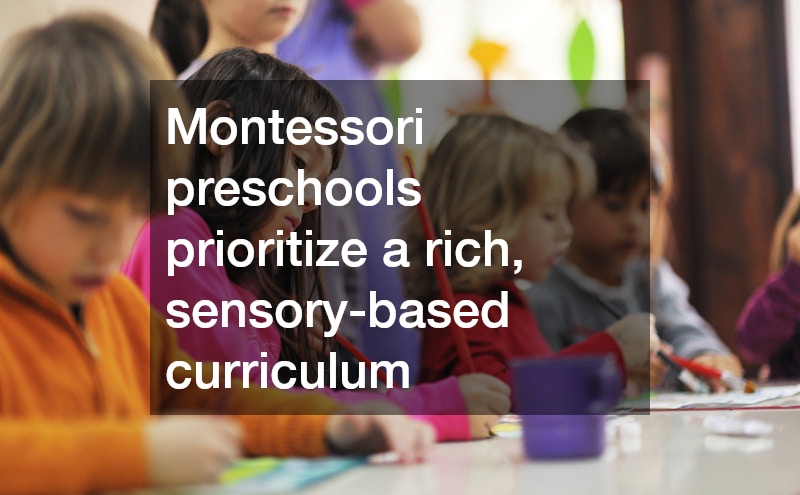
Montessori preschools prioritize a rich, sensory-based curriculum that emphasizes individualized learning paths where children are free to explore subjects that spark their interest. The learning materials are specifically designed to be manipulatives, aiding in sensory experiences that reinforce concepts of math, language, culture, and more. Unlike conventional methods that rely heavily on rote memorization, Montessori materials help children make tangible connections with concepts, thereby deepening their understanding. Carefully sequenced activities encourage incremental learning, building progressively complex knowledge through active discovery. For families considering Montessori education, understanding how these materials stimulate intellectual growth and curiosity can be enlightening.
The individualized curriculum in Montessori preschools acknowledges the varying stages of development among children, allowing for personalized learning plans. Teachers observe each child’s progress closely to provide tailored guidance, ensuring challenging yet achievable goals. This ongoing assessment caters not only to enhancing academic skills but also fulfills emotional and social needs, therefore producing well-rounded learners. Moreover, this learner-centric approach accentuates a child’s inherent passion for learning, framing education as an enjoyable pursuit rather than an obligation. Parents should evaluate how Montessori preschools differentiate this methodology from other educational models, recognizing its potential benefits in meeting their child’s educational needs.
Learning in a Montessori environment transcends textbooks with methods that immerse children in initial real-world contexts, aiding both academic and practical life skills. In addition to academic subjects, activities that foster independence in everyday tasks like cleaning, gardening, and cooking hold a significant place in the curriculum. These exercises not only enhance motor skills and coordination but also imbue a sense of responsibility and confidence. A Montessori preschool thus aims to craft an adaptable skillset, preparing children for the dimensions of life beyond academics. Families should find solace in knowing that these elements groom children for diverse future scenarios by fostering resilience and adaptability.
Assessing Montessori for Your Child
Choosing a Montessori preschool requires parents to consider whether their child’s learning style aligns with this educational philosophy. Children who thrive in environments that offer flexibility and autonomy often excel in a Montessori setting, where the emphasis is on choice and independence. If the child shows self-motivation, curiosity, and a tendency for hands-on learning, Montessori might be a beneficial path. On the other hand, if a child needs significant structure and direct instruction, it’s important to assess how Montessori principles can accommodate and support these needs. Parents should reflect on their child’s individual traits and how these align with Montessori objectives to make an informed decision.
Parental involvement is another crucial aspect of Montessori education. Engaging with Montessori practices at home complements the learning acquired at preschool, solidifying concepts and facilitating smooth transitions between settings. Parents are encouraged to stay informed and participate in school activities, fostering a collaborative atmosphere that benefits their child’s development. Workshops and parent education sessions are often available to support parents in understanding Montessori principles, which can be seamlessly integrated into home life. Evaluating these opportunities can equip parents with strategies to reinforce learning and nurtures a cohesive and supportive educational ecosystem for their child.
Financial considerations are also an integral part of choosing a Montessori preschool. This educational model is often perceived as a premium option with corresponding tuition rates, reflecting the quality of materials and teacher training provided. Families should comprehensively evaluate budgets and seek clarity on available scholarships or financial aid options offered by institutions. Additionally, understanding the long-term educational and personal dividends Montessori education offers can help justify and plan for the investment. It’s imperative for parents to weigh these factors thoroughly, ensuring a sustainable commitment to their child’s Montessori education journey.