

For families exploring education options beyond the standard public school path, the term ” preparatory school” comes up often, but its meaning can feel a little fuzzy. Is it the same as private school? Is it only for older kids? Does “prep school” mean something different depending on where you live? The answers matter, especially if you’re trying to decide whether this kind of education is the right fit for your child.
A preparatory school, often shortened to “prep school,” is a private, independent institution designed to prepare students academically and personally for the next stage of their education, most commonly college. While the term can apply to schools serving students at various ages, it’s most closely associated with secondary education, covering roughly grades 9 through 12, though many prep schools also include middle school or even elementary grades under the same roof.
What Sets a Preparatory School Apart From Other Private Schools
Not every private school is a preparatory school, and understanding the distinction helps clarify what makes this model unique. While all preparatory schools are private, not all private schools brand themselves as “preparatory.” The defining feature of a prep school is its singular focus: getting students ready for college, both academically and socially.
This focus shows up in a few consistent ways. Preparatory schools typically maintain smaller class sizes than public schools, allowing teachers to give more individualized attention to each student. Curricula tend to be rigorous, often incorporating Advanced Placement (AP) courses, honors tracks, or International Baccalaureate (IB) programs well before students reach their final years of high school. Many prep schools also require a foreign language, in-depth writing instruction, and coursework that goes beyond state minimum requirements.
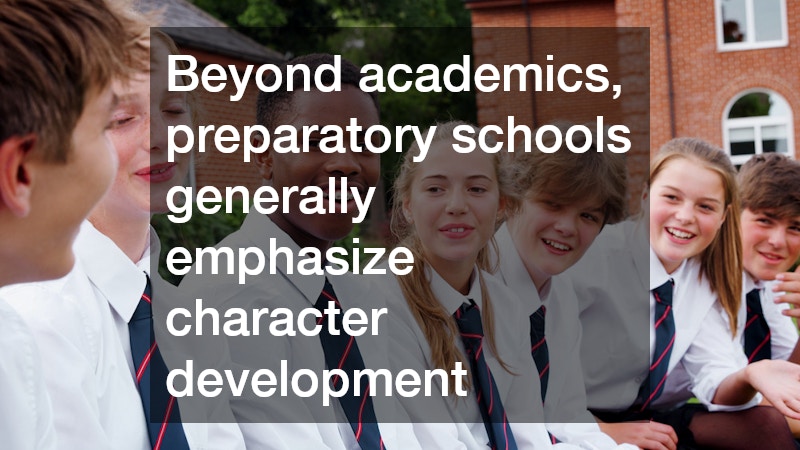
Beyond academics, preparatory schools generally emphasize character development, leadership skills, and extracurricular involvement as core parts of the student experience, not afterthoughts squeezed in around test prep.
A Brief History of Preparatory Schools
The concept of the preparatory school has roots stretching back centuries, originating in England as institutions meant to prepare young boys for elite secondary schools like Eton and Harrow. When the model made its way to the United States in the 18th and 19th centuries, it evolved into something distinctly American: schools built to prepare students specifically for college admission, rather than for another tier of secondary schooling.
Early American prep schools, such as Phillips Academy and Phillips Exeter Academy, set the template that many institutions still follow today: a demanding academic curriculum paired with residential or day-school structures, strong alumni networks, and a culture centered on discipline and achievement.
Day Schools vs. Boarding Schools
One common point of confusion is whether preparatory schools require students to live on campus. The answer is: it depends on the school. Preparatory schools generally fall into two categories.
Day schools operate much like traditional schools, with students attending classes during the day and returning home each evening. This model allows families to be closely involved in their child’s daily life while still providing access to a college-preparatory curriculum and smaller class sizes.
Boarding schools, on the other hand, provide on-campus housing, meals, and structured schedules that extend well beyond the classroom. Students live at the school throughout the academic year, which fosters independence, tight-knit community bonds, and a fully immersive academic environment. Some schools offer a hybrid model, welcoming both boarding and day students within the same institution.
What to Expect Academically and Socially
Because preparatory schools are designed with college readiness as the end goal, the academic experience tends to be more intensive than what’s typically found in public school settings. Students can expect a heavier homework load, frequent writing assignments, and teachers who push for depth of understanding rather than surface-level memorization.
Class discussions often play a larger role than in traditional lecture-based classrooms, with many prep schools favoring Socratic or seminar-style teaching methods that encourage students to engage critically with material. Standardized test preparation, college counseling, and application support are also typically built directly into the school’s programming, starting well before senior year.
Socially, preparatory schools tend to cultivate strong communities. Extracurricular activities such as athletics, arts, debate, and community service are often mandatory or strongly encouraged, based on the philosophy that a well-rounded education extends beyond textbooks.
Who Attends Preparatory Schools?
While preparatory schools were historically associated with wealthy families, today’s landscape is more varied. Many schools now offer need-based financial aid, scholarships, and tuition assistance programs aimed at making a preparatory education accessible to a broader range of students. Families choose preparatory schools for a variety of reasons: dissatisfaction with local public school options, a desire for smaller class sizes, interest in a particular academic specialty, or a wish for a more structured, achievement-oriented environment.
Is a Preparatory School the Right Choice?
Deciding whether a preparatory school fits your family depends on your child’s learning style, your educational priorities, and practical considerations like cost and location. For students who thrive in structured, academically challenging environments and benefit from close mentorship, a preparatory school can offer a strong foundation for college and beyond. Touring campuses, talking with current families, and reviewing a school’s specific curriculum and outcomes are all useful steps toward making an informed decision.